Who is eligible to apply for the Game Development Sector Rebate (GDSR)?
The purpose of the GDSR is to support the ongoing development and growth of the game development sector in Aotearoa New Zealand.
The GDSR enables eligible businesses to receive a rebate equal to 20 percent of their eligible game development costs. To qualify, they must spend at least NZD $250,000 within the 1 April to 31 March financial year, with a maximum annual rebate of NZD $3 million.
A business may be eligible to apply for the GDSR if it is a registered New Zealand business with a New Zealand Company Number; or a foreign company that has both a permanent establishment in New Zealand and a New Zealand Company Number. In addition, the business must undertake relevant game development activities within New Zealand.
While the focus of the rebate is predominantly on businesses developing video games, businesses developing digital assets for the games sector may also qualify.
Is the rebate open to individual game developers?
Yes, it is open to individual game developers – just as long as you meet the requirements as laid out in the GDSR Guidelines, including a company number and the $250,000 minimum eligible expenditure threshold for the financial year.
Are there any restrictions to the type of game genre that would qualify?
Yes, there are certain restrictions. The GDSR will not apply to expenditure on digital games that:
- are a gambling service, substantially comprised of gambling. or include game mechanics that allow real money winnings;
- contain material that would be refused classification by Te Mana Whakaatu Classification Office;
- contain pornography;
- are gamified software primarily designed for another purpose (e.g. gamified quizzes, accounting software, corporate training software, software to support business operations);
- are linear content with no or limited interactivity (e.g., a 360-degree movie played on a VR headset);
- are intended for commercial advertising purposes or to primarily commercialise a product, entity or service.
You can find more on these restrictions, as well as what does qualify as an eligible game, in the GDSR Guidelines.
Is there any issue with a satellite studio or subsidiary of a foreign company applying? If the subsidiary was based in New Zealand?
As long as the subsidiary is a New Zealand–registered business, and all remuneration-related expenditure is for employees or contractors domiciled in Aotearoa New Zealand, there would be no issue with the subsidiary applying for the GDSR.
On the financial submission for the GDSR Application – is it necessary to provide audited financial statements?
If your financial statements have been audited then that is great but no, any financial statements you put forward do not need to have been audited.
In terms of a Parent/Subsidiary: is it the parent company that should be the one applying or can the subsidiary apply directly?
The key consideration here is to ensure there is no ‘double dipping’ in expenditure across multiple applications and to direct the rebate to those businesses that are in line with the policy intent of the GDSR – ie. to support the ongoing development and growth of the game development sector in Aotearoa New Zealand. Conceptually, this points to the claimant as a game development studio and not its contractors. It also points to the claimant as a self-standing studio with a Company Number that meets all other factors of eligibility, and not a holding company that has no eligible game development activity of its own. Whichever company best fits this description is the one that should apply – but it can be either the parent or subsidiary.
You will need to provide details on your overall company structure, including any parent companies, as part of your application.
Does the GDSR fund offshore activities for studios with overseas owners?
No, the GDSR only provides a rebate on eligible game development activity undertaken in New Zealand by eligible, New Zealand-based businesses (with a New Zealand Company Number).
The rebate is designed to incentivise businesses to carry out development work locally, including hiring New Zealand-based talent and investing in the domestic games sector. As a retrospective rebate, it applies only to expenditure on eligible activities that have already been performed in New Zealand. Applicants are also required to be registered locally, including holding a New Zealand Company Number.
While some studios may have international ownership and operate or undertake work across multiple countries, any development activity carried out overseas is not eligible for the rebate.
The GDSR is specifically targeted at supporting and growing game development within New Zealand. This is already contributing to sector growth, with GDSR recipients increasing their New Zealand-based employee numbers by 20% between the first and second years of the programme.
Are GDSR recipients typically small, medium or large studios?
The majority of studios supported through the GDSR are small to medium-sized New Zealand businesses.
While a small number of larger studios also receive the rebate, the programme is not solely focused on large companies. The GDSR plays an important role in supporting emerging and mid-sized studios to build capability, gain momentum and scale sustainably over time.
At the same time, larger studios contribute significantly to the broader ecosystem - helping to build workforce capability and support the development of experienced talent. There is also a cap on the amount any one business can receive through the GDSR, which helps ensure funding is distributed more broadly. Together, these settings help support the emergence and growth of new studios and a more resilient and mature game development sector overall.
If our application is declined or some costs are assessed as ineligible, can we discuss the decision and submit an appeal?
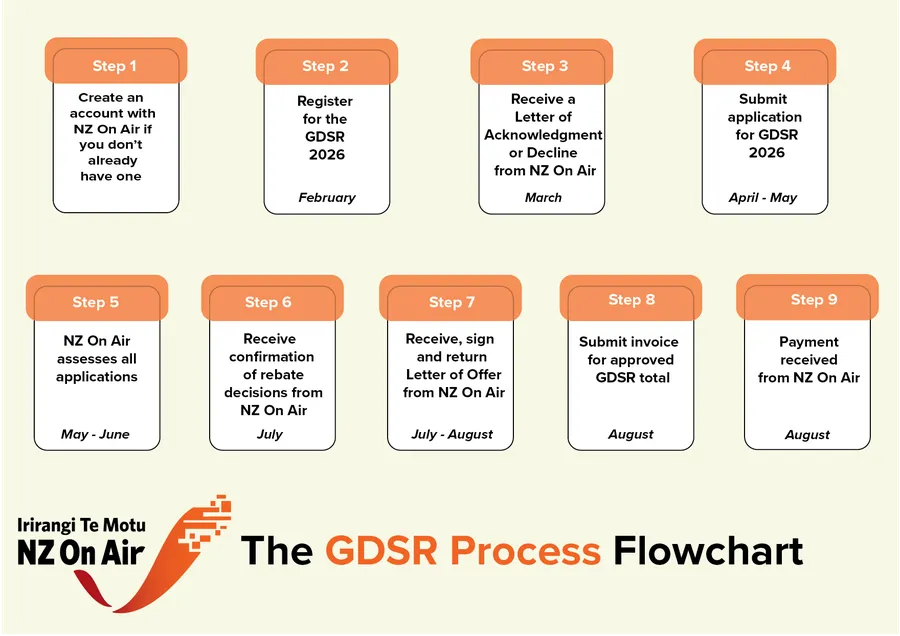
Yes, if your application is declined, or you believe some of your claimed costs have been assessed as ineligible in error, you can discuss the outcome with us and, if needed, submit an appeal. Appeals are accepted once GDSR payments have been processed in July and must be lodged by the end of August in the same year. Appeals received outside this window cannot be considered.
To start, you will be provided the opportunity to book a call with the NZ On Air team during the month of August to better understand the decision, talk through the assessment and ask any questions you may have.
If, after that discussion, you would still like to appeal, you may submit a formal appeal in writing. Your appeal should clearly outline the decision you’re challenging and include any additional information or evidence to support your claim.
All appeals are reassessed by NZ On Air between September and November, with a final outcome provided before the end of the calendar year.
If the appeal results in a corrective payment, NZ On Air will request an invoice. Payments are typically made in January, once the audit process has been completed, so any adjustments can be processed together.
Regarding accreditation, is there an expectation to have accreditation both in game credits and on our business’ website, or is it just one or the other? For some games (e.g. mobile free-to-play) we don't always have credits.
To start with, all recipients of the GDSR are required to acknowledge the support of the GDSR scheme through NZ On Air via accreditation.
Accreditation should appear on both your business and game website (if you have one), and somewhere within the game itself. This doesn’t need to be in the credits specifically—it could be in a menu, splash screen or any other appropriate location.
We also understand that for some businesses you may be working with a client whose IP has strict accreditation rules. If that is the case, feel free to contact us—we’re happy to discuss options and find a workable solution.
We also appreciate the challenge of updating live games, especially across multiple platforms. That’s why recipients have up to six months to implement accreditation.
Static and animated logos are available on our website, along with our Accreditation Guidelines. When referring to the scheme in writing, we recommend using the following copy: Supported by the NZ Game Development Sector Rebate.
If you’d like to discuss what might work best for your game or business, please get in touch at gamesrebate@nzonair.govt.nz.
Can I request an extension for my GDSR application?
No, extensions are not generally permitted. However, in exceptional circumstances - such as the death of an immediate family member - you may submit a written request for consideration.
Requests must be made before applications close and will be assessed by NZ On Air on a case-by-case basis.
Please note that the assessment and payment process must still be completed before the Government’s financial year ends in June. This means that any extension granted would be for a short period only.
What happens if two New Zealand studios apply for the GDSR for the same game?
There are a couple of possible outcomes, depending on the nature of the costs being claimed.
If each studio is applying for a clearly different cost base — for example, one studio is claiming costs related to prototyping while the other is claiming costs related to later-stage production — both studios may be eligible to receive a rebate for their separate contributions.
However, where both a client studio and a contracted (work-for-hire) studio submit claims relating to the same cost base for the same game, the GDSR defaults to the client studio. As set out in the GDSR Guidelines, “businesses may not claim expenditures for which another business has already claimed. For clarity, when contractors are engaged, any rebate claim should only be made at the top-most, New Zealand-based company level — for example, the owner of the project, not at the contractor level.”
To avoid confusion, we recommend that work-for-hire studios have a conversation with their client in advance to confirm whether the client intends to apply for the GDSR. If the client does not plan to apply, the contracting studio may submit a claim for its eligible costs.
Does NZ On Air have editorial oversight over games created by GDSR-funded studios?
No, NZ On Air does not have editorial oversight over the content of games funded through the GDSR.
The GDSR is an economic rebate, and NZ On Air administers it within the policy settings established by the Ministry of Business, Innovation and Employment (MBIE). Within this framework, we do not have editorial oversight over game content. Instead, the GDSR is a retrospective rebate focused on whether a business’ expenditure activities performed in New Zealand meet a set of key eligibility criteria.
This includes assessing:
- whether the applicant is an eligible New Zealand-based business (or has a permanent establishment in New Zealand) and holds a New Zealand Company Number
- whether the business is undertaking eligible game development activities
- whether the game meets the definition of an eligible digital game (including interactivity, format and intended public release)
To be eligible, games must be intended for public release and for entertainment or educational purposes, and must not include material that contains pornography or gambling mechanics involving real-money winnings.
Is cultural consultation an eligible expense under the GDSR?
Yes, cultural consultation is an eligible expense under the GDSR.
Where a game includes cultural elements, studios are encouraged to engage appropriate cultural expertise when their work draws on cultural material. The GDSR supports this in practice by providing a 20% rebate on eligible cultural consultation costs.
Does NZ On Air assess cultural content in GDSR-funded games?
NZ On Air acknowledges that cultural representation, including the risk of cultural appropriation, is an important and complex topic in game development, and one that deserves careful consideration. We strongly encourage studios to approach cultural content thoughtfully and to engage appropriate cultural expertise where relevant. The GDSR also supports this in practice, by providing a 20% rebate on eligible cultural consultation and related expenditure.
It is important to note that the GDSR is an economic rebate, and NZ On Air operates within the policy settings established by MBIE. Within this framework, we do not have editorial oversight over the content of games, nor a legal mandate to assess or make determinations on cultural representation beyond the eligibility criteria set out in the policy.